Your GCC has a structural leadership gap. It sits in the middle.
Most GCCs are built strong at the top and strong at the technical base. The mid-senior layer — the programme managers, senior ICs, and emerging leaders who translate strategy into execution — is where the gap lives. That gap has a cost. And it is now measurable.
Request a 20-minute conversationThe hourglass problem. And why standard L&D does not reach it.
Research on evolving GCC structures points to a consistent pattern across mature India-based capability centres: strong global executive presence at the top, strong technical talent at the base — and a brittle mid-senior layer in between.
This is not a talent pipeline problem. It is a structural one. The leaders in that middle layer have the technical depth. What they do not have is the communication infrastructure to make that depth land with global decision-makers — the ability to challenge a senior opinion diplomatically, to translate a technical recommendation into business language, to hold a position under pressure when the SVP on the call disagrees.
PwC India's research Catalysing Value Creation in Indian Global Capability Centres (2025) identifies the alignment deficit between GCC mid-senior leaders and global stakeholders as one of the defining strategic risks of the current GCC maturity phase. The research identifies misalignment-driven value loss as the risk—not a lack of technical talent. The risk is not that GCCs lack talent. It is that the talent they have cannot operate credibly at the level the business now requires.

The gap is not at the top. It is not at the base. It is in the layer that connects them.
In one 50-leader cohort, the readiness risk was measurable.
In late 2025, Gravitas Academy ran a pre-programme diagnostic with 50 high-potential leaders at a leading BFSI GCC in India. These were not early-career hires. They were leaders already earmarked for the next level — operating in a complex, global, highly regulated environment where strategic credibility is not optional.
Under the Gravitas diagnostic rubric, 45 of the 50 leaders met the internal risk threshold for strategic readiness. This was a finding about this cohort—not a market-wide estimate. The recurring constraints were cross-functional influence, strategic visibility, and proactive opportunity sensing.
This is the hourglass in practice: technically excellent, operationally reliable, and strategically underprepared for the rooms they are already sitting in.
Evidence boundary
Owner: Gravitas Academy. Sample: 50 high-potential leaders in one Indian BFSI GCC, assessed before the programme in late 2025. Basis: anonymised internal diagnostic classifications against the Gravitas rubric; not externally audited and not a claim about all GCC leaders. Satisfaction scores are omitted because they do not demonstrate behavioural or business change.
The readiness classification in this 50-leader cohort did not mean the organisation had made no L&D investment. The gap exists because standard executive presence programmes are designed to fix a knowledge problem. The assumption is: if the leader knew more about communication frameworks, stakeholder management theory, or executive presence models — they would perform differently.
The problem in the middle of the hourglass is not a knowledge problem. It is a permission problem. The gap is the 1.5-second window between recognising that you should challenge the senior opinion and the reflex that says — not my place.
That reflex is not addressed by a framework. It is addressed by structured practice under conditions close enough to the real thing that the nervous system begins to update its response. Most L&D programmes were not designed to go there.
Prior organisational engagements include a leading BFSI GCC (India), a leading semiconductor GCC (Chennai), and organisations across financial services, technology, and professional services.
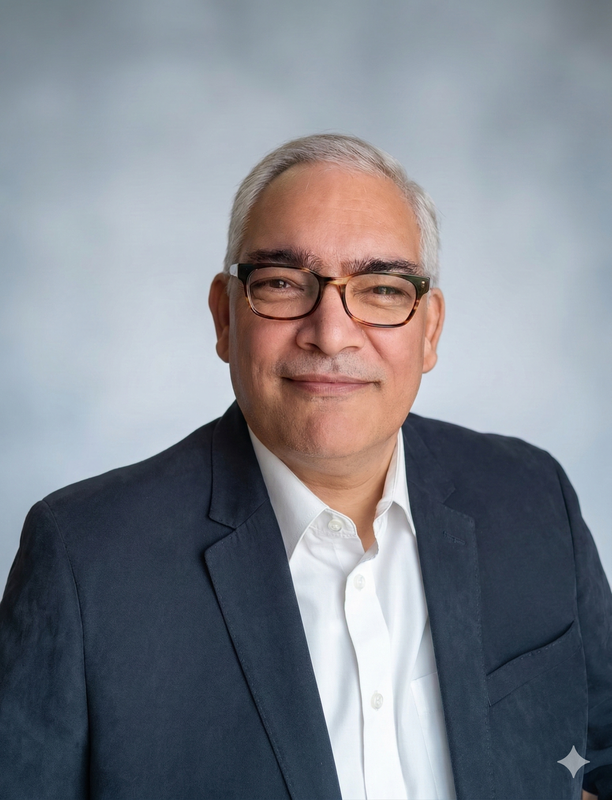
Rajiv Upadhyay is a Marshall Goldsmith-certified executive coach with 25+ years of Fortune 500 leadership experience across DBS, ANZ, and Société Générale. He works with senior IT leaders at India's GCCs and MNCs on the specific transition from technically excellent to globally credible.
He does not run generic leadership programmes. Every engagement begins with a diagnostic. Every intervention is designed for the specific gap in the specific team.
Three questions worth sitting with.
In your organisation's most senior cross-functional meetings, what percentage of your India-based programme managers and senior leaders are actively shaping the conversation — as opposed to presenting updates and deferring?
When a senior director challenges a technical recommendation in a live meeting, what does your team's default response look like? Is that the response you want representing your centre's credibility at the global level?
Your organisation is investing in GenAI skills, data science capability, and technical reskilling. Who is investing in the communication infrastructure that determines whether those capabilities get heard?
Not a proposal. Not a pitch. A 20-minute conversation about whether this is relevant to your context.
Request a conversationgravitas@gravitaslpi.net · rajivupadhyay.com